Player Profile: Israel Zilber
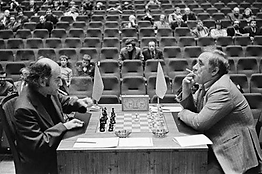
There are chess players whose careers are neatly recorded in books, with famous tournaments, medals, photographs and clear endings. Then there is Israel Zilber, a player whose life reads almost like a chess mystery.
Born in Riga, Latvia, on June 25, 1933, Zilber grew into one of the strongest players in Latvia during the Soviet era. He was not a world champion, but he was strong enough to defeat some of the greatest names in chess. His peak rating eventually reached 2430, a very high level for his time.
A Champion in the Shadow of Tal
Zilber first made his mark in Latvian chess during the 1950s. He played in the Latvian Championship again and again, steadily climbing the standings.
Then came 1958.
Zilber won the Latvian Championship, finishing ahead of two extraordinary players: Aivars Gipslis and the legendary attacking genius Mikhail Tal. Imagine winning your country's championship while one of the most dangerous attacking players in chess is sitting in the same tournament.
And Zilber had already shown that Tal was not unbeatable.
In 1952, Zilber defeated the young Tal in a Latvian championship game. Six years later, their meeting became even more important. Zilber faced Tal in the deciding battle of the 1958 Latvian Championship and emerged as champion.
For a young chess fan, there is an important lesson here: sometimes the player who is less famous can still be the one who finds the winning move.
Strong Enough for the Soviet Championship
The Soviet Union was home to an incredible concentration of chess talent. Players such as Tal, Botvinnik, Spassky and Petrosian competed in an environment where even reaching the top was extremely difficult.
Zilber reached the semifinals of the Soviet Championship four times, in 1956, 1957, 1958 and 1962. He also represented the Latvian Soviet team in several major team championships.
He was also a regular force in Latvian chess. He finished second in the Latvian Championship in 1956 and 1962, third in 1964, and second again in 1972. He became Riga champion in 1962 and 1974.
For more than two decades, Zilber was a serious competitor.
Then his life took a dramatic turn.
From Latvia to New York
After 1974, Zilber moved first to Israel and later to the United States. His chess career did not end. Far from it.
He played at Hastings in 1979 and won the Masters Open in Biel in 1980. He also won a tournament in Limoges in 1981. His rating reached 2430 in January 1980.
But away from the tournament halls, Zilber's life became much harder.
He eventually became homeless and spent much of the 1980s living on the streets of New York. Yet even there, chess remained part of his life.
He played in Washington Square Park, one of New York's famous chess gathering places. According to Fred Waitzkin's book Searching for Bobby Fischer, Zilber was considered the strongest regular player there apart from grandmaster Roman Dzindzichashvili.
Think about that scene for a moment.
A man who had once battled Tal in championship halls was now sitting in a New York park, playing chess against strangers.
The Mystery
The final chapter of Zilber's life is the strangest.
There is no completely reliable account of what happened to him. One story claims that he died during a harsh winter. Another suggests that he may have survived because his name does not appear in the Social Security Death Index. Neither story has been firmly established.
And so Israel Zilber remains something of a chess mystery.
We know he was a Latvian champion. We know he defeated Tal. We know he stood among the strong players of Soviet Latvia. We know he later won international tournaments. We know that, despite terrible hardship, he continued to play chess in Washington Square Park.
But we do not know exactly how his story ended.


Comments